


Starting a business in Indonesia involves several steps, but one requirement stands above all others: selecting the correct KBLI code. The Klasifikasi Baku Lapangan Usaha Indonesia (KBLI), or Indonesian Standard Industrial Classification, serves as the foundation for all foreign business operations in the country. This five-digit code system determines everything from licensing requirements to investment amounts, making it essential for successful market entry.
What is KBLI and Why Does it Matter?
KBLI is Indonesia’s official business classification system created by the Central Bureau of Statistics (BPS). Think of it as a detailed catalog that organizes every type of business activity in Indonesia into specific categories. Each business receives a unique five-digit code that tells the government exactly what your company does.
For foreign business owners, KBLI codes are not just numbers; they are the keys that unlock business opportunities in Indonesia. These codes determine whether your business can operate legally, how much capital you need to invest, and what licenses you must obtain.
The most recent version is the 2020 KBLI which the BPS has issued through BPS Reg. No. 2/2020, which subsequently revokes the 2015 and 2017 KBLI. Moreover, the 2020 KBLI has accommodated various types of emerging business models that were not provided for by the 2017 KBLI.
The Structure of KBLI Codes
The KBLI has been developed with reference to the International Standard Classification of All Economic Activities (ISIC) system created by the United Nations, to a level of 4 (four) digits and adjusted to the ASEAN Common Industrial Classification (ACIC) and East Asia Manufacturing Statistics (EAMS). Due to the conditions of economic activities in Indonesia, the 2020 KBLI develops up to the level of 5 (five) digits which is now applicable in Indonesia.
The structure of the KBLI numbers in the 2020 KBLI according to the BPS is as follows:
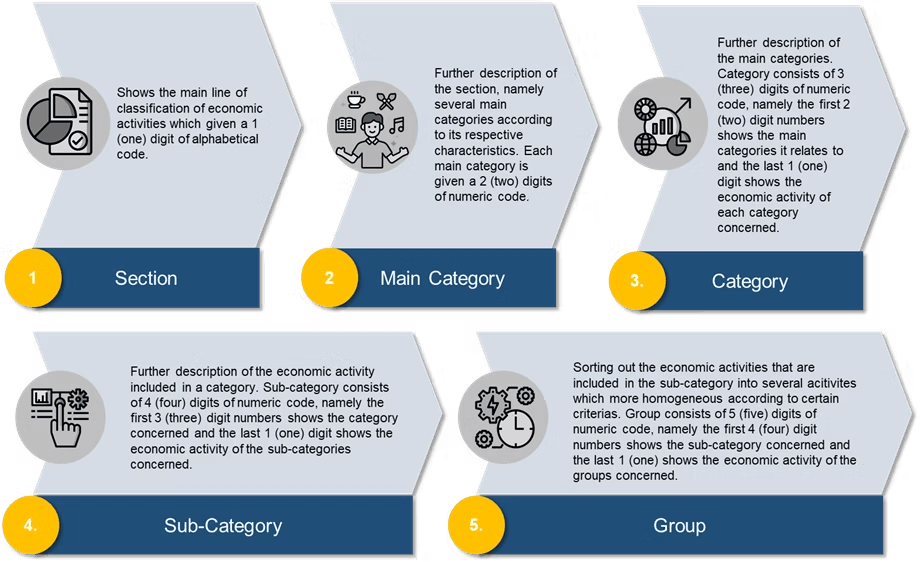
The KBLI system uses a hierarchical structure that becomes more specific at each level:
- First digit: Broad economic sector (like manufacturing or services)
- Second and third digits: Sub-sector identification
- Fourth and fifth digits: Detailed activity classification
For instance, the structure of KBLI No. 46312 for trading activity of fruits is as follows:
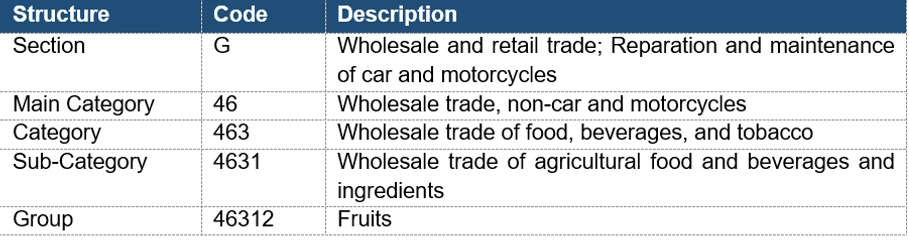
How to Research KBLI Codes
Below is an explanation of how to research KBLI codes
(Source: https://tricruise.id/column/kbli-code-indonesia/).
1. Access the website and search by keyword
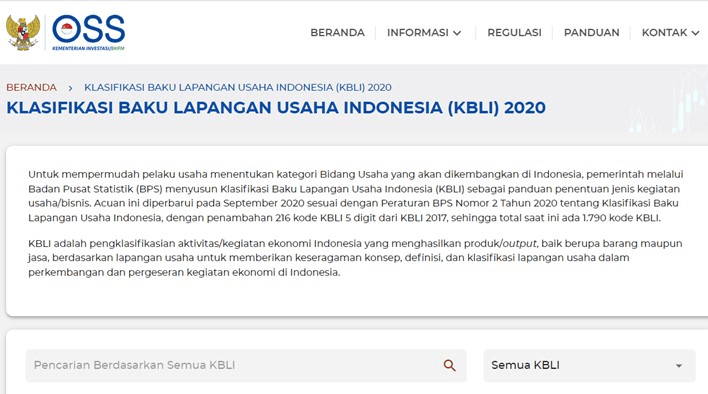
First, visit the [Klasifikasi Baku Lapangan Usaha Indonesia (KBLI) 2020] website and type relevant keywords for the business you wish to research into the search box.
For instance, if you are researching businesses related to education, enter “Pendidikan (education),” or if your focus is on consulting businesses, type “Konsultasi (consulting).”
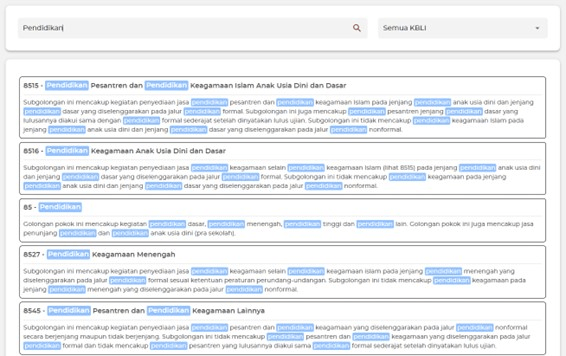
The image above shows the search results for “Pendidikan (education),” which returned items like:
- 8515 – Islamic boarding school education and Islamic religious education for infants and elementary school students
- 8516 – Religious education for infants and elementary school students
- 8527 – Secondary religious education
2. Find the relevant business and click on the KBLI code
From these search results, click on the KBLI code of the relevant business to check the details.
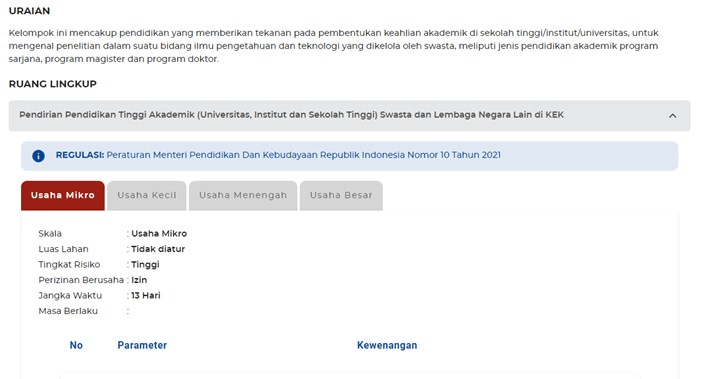
The image above shows the page for KBLI code “85321” for “Pendidikan tinggi akademik swasta (private academic higher education).”
3. Select the business scale and check the content
You can view the content for four business scales: Usaha Mikro (micro-scale business), Usaha Kecil (small business), Usaha Menengah (medium business), and Usaha Besar (large business). Here we will focus on Usaha Mikro.
The classifications are defined as follows:
- Micro-scale business (Usaha Mikro): Capital less than 1 billion Rupiah (approximately $64,000)
- Small business (Usaha Kecil): Capital between 1 billion and 5 billion Rupiah (approximately $64,000 – $320,000)
- Medium business (Usaha Menengah): Capital between 5 billion and 10 billion Rupiah (approximately $320,000 – $640,000)
- Large business (Usaha Besar): Capital of 10 billion Rupiah or more (approximately $640,000 or more)
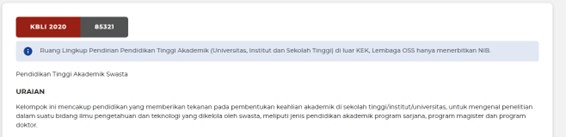
There are primarily two points to check on this page.
The first is “URAIAN (explanation)” which describes the business overview.
For example, this KBLI code “85321” states “Education that emphasizes the formation of expertise in familiarizing with scientific and technological research in the fields of higher education, research institutes, universities, including types of academic education at the undergraduate and master’s degree levels, and doctoral programs operated by the private sector.”
Depending on the business content, another business code might be more appropriate, or additional KBLI codes may need to be obtained, so it’s important to correctly verify whether the code truly matches the business you plan to start.
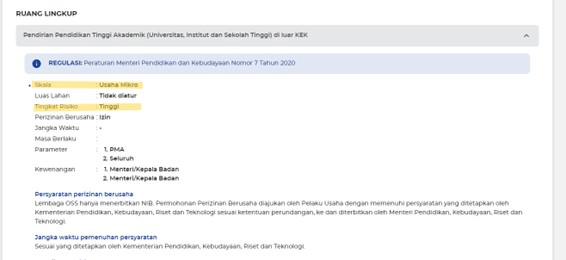
The next item to check is “RUANG LINGKUP (scope)” below URAIAN. This section describes the range of companies that can conduct this business and the business risks.
The top “Skala” indicates the business scale, describing the treatment when a micro-scale business (Usaha Mikro) starts operations. Here, a micro-scale business refers to economic activities by individuals or individual business entities, with clearly defined criteria such as having net assets of 50 million Rupiah (approximately $3,200) or less and maximum annual sales revenue of 300 million Rupiah (approximately $19,200).
Additionally, the “Tingkat Risiko” item two items below refers to the risk level. The risk level for this business is written as “Tinggi (high),” meaning it is a business with the highest risk level.
The required procedures and documents for business establishment vary depending on this risk level. Below are the required documents for each risk level for reference:
| Risk Level | Required Documents |
| Risiko Rendah (Low Risk) | ・NIB (Business Identification Number) |
| Risiko Menengah Rendah (Medium-Low Risk) | ・NIB (Business Identification Number)・Self-declared certificate |
| Risiko Menengah Tinggi (Medium-High Risk) | ・NIB (Business Identification Number)・Certificate approved by local government |
| Risiko Tinggi (High Risk) | ・NIB (Business Identification Number)・Permission from local government・Certificate approved by local government |
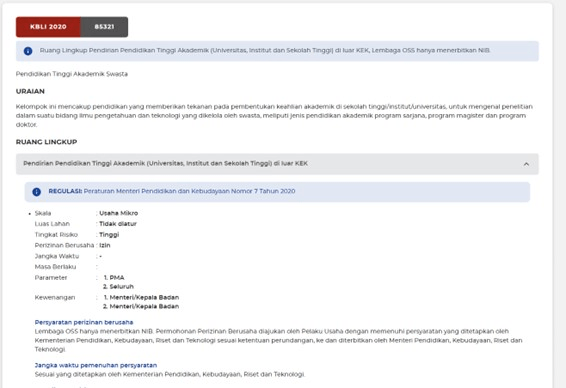
This page also includes information about the land area required for the business and business licenses, so make sure to check these details.
- Reference 1: Website Portal Kelurahan Sukorejo “Pengertian UMKM Menurut Undang-Undang, Kriteria, dan Ciri-Ciri UMKM”
- Reference 2: Kementerian Investasi BKPM “MEKANISME PERIZINAN BERUSAHA BERBASIS RISIKO|P9. Tingkat Risiko”
Foreign Companies and KBLI Codes
When establishing a company in Indonesia, there are different rules for domestic and foreign companies.
Particularly when establishing a foreign company, the costs can vary by hundreds or millions of US dollars depending on how many business licenses are obtained and what type of business is started, so caution is necessary.
Here, we will explain the KBLI code rules you should know when establishing a foreign company in Indonesia.
1. Adding one business license requires $640,000
For foreign companies, a capital investment of 10 billion Rupiah (approximately $640,000) excluding land and buildings is required for each additional business license (KBLI code).
The key point is that capital payments are linked to KBLI codes, not to companies. The minimum shareholder contribution is 10 million Rupiah (approximately $640).
However, note that rules differ by business: construction businesses require at least 25 billion Rupiah (approximately $1.6 million) in capital, real estate businesses in the form of entire buildings or integrated residential areas require over 10 billion Rupiah (approximately $640,000) including land and buildings (Government Regulation No. 5 of 2021).
2. Capital requirements differ by business content/scope even with the same objective
| (1) Wooden, rubber, cloth products | (2) Iron products (keychains, etc.) | (3) Plastic products | |
| (A)Manufacturing | KBLI32402Industri Mainan Anak-anak: Dolls, figures, card games, etc. | KBLI 25999Industri Barang Logam Lainnya YTDL: Toys containing iron | KBLI22299Industri Barang Plastik Lainnya YTDL: Toys containing plastic |
| (B)Wholesale | KBLI46495Perdagangan Besar Alat Permainan dan Mainan Anak-anak: General toy wholesale | KBLI46699Perdagangan Besar Produk Lainnya YTDL: Wholesale of iron and plastic toys | Wholesale of iron and plastic toys |
For example, if establishing a company with the objective “to spread Japanese toys in Indonesia,” and engaging in the “manufacturing of dolls and figures,” only the KBLI 32402 business license is needed.
However, if engaging in both “manufacturing of dolls and figures” and “sales of dolls and figures,” the business licenses would be KBLI 32402 and KBLI 46495.
As mentioned earlier, in Indonesia, capital payments are linked to KBLI codes, not companies.
Since 10 billion Rupiah (approximately $640,000) is newly required for each additional KBLI code, even with the same objective of “spreading Japanese toys in Indonesia,” the cost can differ by millions of dollars depending on the business scope and content.
3. Multiple KBLI codes exist even with the same objective
Similar to the toy manufacturing and sales case, KBLI codes are not necessarily the same even with the same objective. For example, even with the objective of “establishing a company that can conduct educational business,” there are multiple business codes as follows:
| Industry | Business Content Examples | KBLI Code |
| Personnel Recruitment | Introducing Indonesian engineers domestically and internationally | 78102 |
| Education Outsourcing | Outsourcing university courses | 85321 |
| Education Outsourcing | Outsourcing pre-introduction education | 85492 |
| Japanese Language School | Providing content centered on e-learning | 85493 |
| Franchise | Support for establishing Japanese language schools | 77400 |
Even under “educational business,” KBLI codes differ depending on business content such as personnel recruitment, education outsourcing, or Japanese language schools, so it’s important to understand which one applies to the company you’re establishing.
Businesses and KBLI Codes Prohibited/Regulated for Foreign Companies
In Indonesia, to protect domestic industries, foreign entry is prohibited or regulated for certain businesses. Finally, here is a summary of businesses (KBLI codes) where foreign companies’ entry is prohibited or regulated for your reference.
1. Businesses Prohibited for Foreign Companies
Two types of business activities are prohibited for foreign companies: “business activities that do not use technology or use only simple technology” and “business activities with unique processes, labor-intensive, and possessing traditional cultural heritage.” Additionally, business activities with capital not exceeding 10 billion Rupiah (approximately $640,000) excluding land and buildings are not permitted.
Furthermore, specific industries such as batik (wax-resist dyeing), wooden building materials, and traditional cosmetics can only be conducted by 100% domestically-owned companies.
2. Businesses Conditioned on Partnerships with Domestic Companies
The following are sectors conditioned on partnerships with domestic small and medium enterprises or cooperatives. Similarly, not all sectors are restricted. The right column for each industry lists the specific business contents that are restricted.
| Sector | Specific Examples |
| Marine Fisheries | Fish breeding/fattening, salt production/extraction, fishery processing industry, fishery product sales |
| Industry | Fish canning, vegetable/fruit pickling industry, soy sauce/tempeh and other bean-based food industries, rattan processing industry, palm industry, essential oil industry, parts and accessories industry for 4+ wheeled vehicles, repair of communication equipment/household appliances |
| Commerce | Leasing of agricultural machinery and office equipment |
| Energy Mineral Resources | Consulting in the field of electrical equipment |
| Information Communication | International courier agency business |
| Public Works/Housing | Building construction, bridge/overpass construction |
The above are businesses that foreign companies can enter by forming partnerships with Indonesian small and medium enterprises or cooperatives. Partnership forms include subcontracting, franchising, distribution and agency, joint ventures, etc.
3. Businesses with Restricted Foreign Investment Ratios
The following are businesses where foreign companies can enter but have upper limits on foreign investment ratios:
- Up to 49% foreign investment: Weapons/firearms, military vehicles/ships/aircraft, radar, domestic shipping/water transportation, air transportation, delivery services
- 100% domestic at establishment, up to 49% foreign for expansion: Newspapers, magazines, media publishing
- 100% domestic at establishment, up to 20% foreign for expansion: Private/paid broadcasting stations
4. Businesses with Special Conditions
While we’ve introduced businesses prohibited/regulated for foreign companies, note that some businesses have individually set investment ratios, such as foreign investment in construction businesses being limited to 67%.
Upper limits on investment ratios vary by field and business, so those planning to start a business should first check the Priority List.
Understand Business Licenses (KBLI Codes) for Company Establishment
While various procedures are necessary to establish a company in Indonesia, it’s important to first understand which KBLI code applies to the business you’re planning to launch.
As explained in this article, even under “educational business,” KBLI codes vary by business such as personnel recruitment or Japanese language schools. Additionally, since adding one KBLI code incurs an additional cost of approximately $640,000, financial considerations are also important.
If you’re considering establishing a company in Indonesia, please use this article to deepen your understanding of business licenses (KBLI codes).
Why KBLI is Essential for Foreign Business Owners
1. Legal Business Authorization
Without the correct KBLI code, your business cannot operate legally in Indonesia. The code defines the exact scope of activities your company can perform. If you operate outside your registered KBLI classification, you risk incurring government penalties or being forced to close.
2. Investment Requirements
Foreign companies must meet specific capital requirements based on their KBLI codes. Most foreign businesses need a minimum investment of IDR 10 billion (approximately $640,000) per KBLI code, excluding land and buildings. Some sectors require higher amounts:
- Construction businesses: IDR 25 billion minimum
- Real estate (integrated developments): IDR 10 billion, including land and buildings
3. Foreign Ownership Eligibility
The KBLI code determines whether foreign investors are allowed to participate in specific business sectors. Indonesia’s Positive Investment List links directly to KBLI codes, showing which activities are:
- Restricted with ownership limitations
- Reserved for domestic investors only
- Completely closed to all investment
4. Licensing and Permits
Each KBLI code carries a risk classification (low, medium, or high) that determines your licensing requirements. Low-risk businesses may only require a Business Identification Number (BIN), while high-risk activities necessitate additional permits and certifications.
How KBLI Affects Your Business Operations
1. Business Scope Definition
Your KBLI code legally defines what services or products you can offer. Companies cannot expand into new business areas without adding appropriate KBLI codes to their registration. This affects everything from marketing activities to operational planning.
2. Tax and Incentive Access
The Indonesian government offers various tax incentives and benefits tied to specific KBLI codes. Priority sectors, identified through KBLI classifications, can access:
- Tax holidays of 5-20 years
- Corporate income tax reductions up to 100%
- Special depreciation allowances
- Simplified licensing procedures
3. Government Relations
KBLI codes help government agencies understand your business activities and provide appropriate oversight. They also facilitate communication with various ministries and regulatory bodies that govern different business sectors.
Choosing the Right KBLI Code
1. Research Your Business Activity
Start by clearly defining your primary business activities. Look beyond general descriptions and identify the specific products or services you plan to offer. The more precise your understanding, the better your KBLI selection will be.
2. Use Official Resources
The Indonesian government provides online tools to search KBLI codes through the OSS (Online Single Submission) system. You can search by keywords related to your business activities to find matching codes.
3. Consider Multiple Codes
Many businesses operate across different sectors and may need multiple KBLI codes. However, remember that each additional code for foreign companies requires meeting the minimum investment threshold.
4. Check Foreign Investment Eligibility
Before finalizing your KBLI selection, verify that foreign investors are permitted to participate in those business activities. Cross-reference your chosen codes with the current Positive Investment List.
Common Mistakes to Avoid
1. Choosing Generic Codes
Many business owners select broad, generic KBLI codes, thinking they provide more flexibility. This approach often leads to licensing complications and may limit access to specific incentives or permits.
2. Ignoring Investment Requirements
Each KBLI code carries specific capital requirements. Failing to budget for these requirements can derail your business establishment process.
3. Mismatching Business Activities
Your actual business operations must align with your registered KBLI codes. Operating outside your registered classification can result in penalties or the closure of your business.
4. Overlooking Restricted Sectors
Some KBLI codes are restricted or closed to foreign investment. Always verify foreign investment eligibility before committing to specific business activities.
The Role of KBLI in Business Licensing
1. Risk-Based Approach
Indonesia employs a risk-based licensing system, where each KBLI code is assigned a corresponding risk classification. This determines the complexity and requirements of your licensing process:
- Low Risk: Basic NIB registration is sufficient
- Medium Risk: Additional standard certificates required
- High Risk: Comprehensive permits and ongoing compliance monitoring needed
2. Online Single Submission (OSS) Integration
The OSS system integrates directly with KBLI codes to streamline business registration. Your KBLI selection automatically triggers the appropriate licensing pathways and requirements.
3. Ongoing Compliance
KBLI codes affect ongoing regulatory compliance. Government agencies use these codes to determine inspection schedules, reporting requirements, and applicable regulations.
Strategic Considerations for Foreign Investors
1. Market Entry Planning
Choose KBLI codes that align with your long-term business strategy. Consider potential expansion plans and market opportunities when making your selection.
2. Competitive Advantages
Some KBLI codes offer access to government incentives and support programs that can provide competitive advantages—research available benefits for your chosen sectors.
3. Partnership Requirements
Specific KBLI codes require partnerships with local Indonesian companies or small and medium enterprises (MSMEs). Factor these requirements into your business structure planning.
Getting Professional Help with EZPZ Indonesia
Getting professional help is essential given the complexity of KBLI selection and its impact on business compliance and growth. Many foreign investors work with local consultants or legal firms who are experienced in Indonesian business classification and can assist through every step of the process.
EZPZ Indonesia stands out as a dedicated service provider, offering tailored support in company setup, KBLI selection, business licensing, and ongoing compliance. Their team helps businesses navigate regulatory requirements, avoid costly errors, and optimize operations, making it easier for foreign investors to succeed in Indonesia’s dynamic market.
Conclusion
KBLI codes represent far more than administrative requirements; they are strategic business decisions that shape your entire Indonesian market entry. The proper selection of KBLI enables legal operation, appropriate capitalization, and access to government incentives. Poor choices can lead to legal complications, increased costs, and lost opportunities.
Foreign business owners must approach KBLI selection with careful research and strategic thinking. Understanding the system’s structure, requirements, and implications is crucial for ensuring a successful business establishment and long-term operational success in Indonesia’s dynamic market.
Taking time to understand and select appropriate KBLI codes properly pays dividends throughout your business journey in Indonesia. This foundational decision affects every aspect of your operations, from initial licensing to ongoing expansion opportunities.